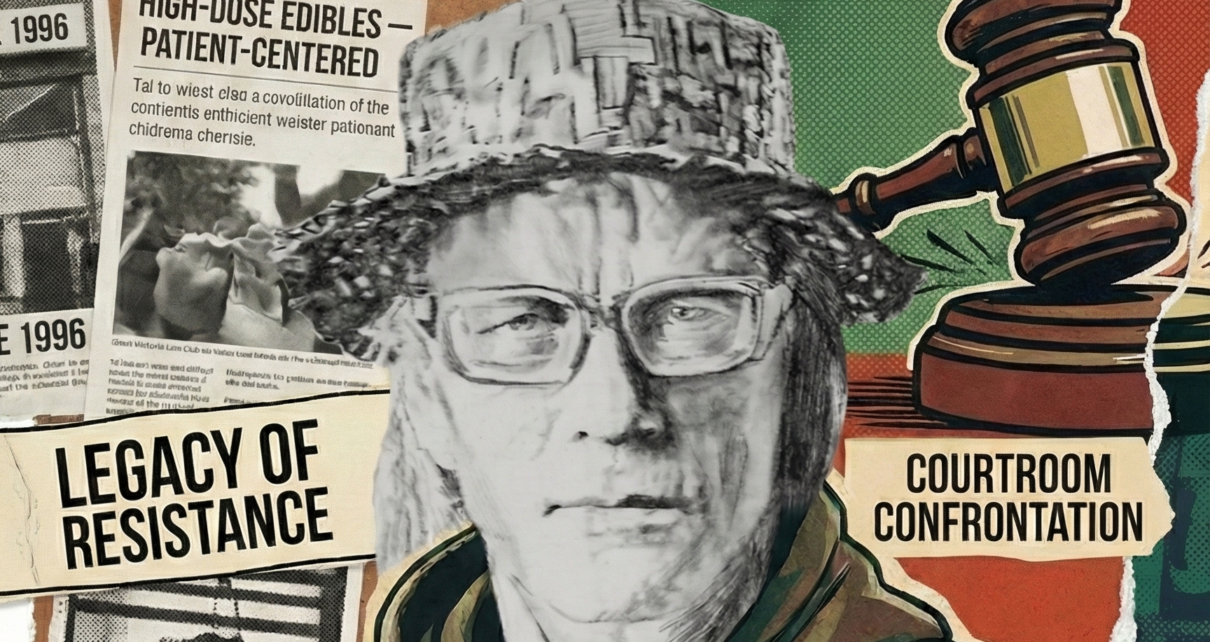
In the long campaign against cannabis prohibition in Canada, few figures embody continuity, resolve, and constitutional memory as clearly as Ted Smith. His presence on the Legacy to Legal panel at the upcoming Grow Up Conference in Vancouver is a continuation of his over 3 decades speaking about cannabis advocacy. Ted stands not as a commentator on history, but as a surviving participant in an unresolved legal conflict, one that legalization promised to end but instead merely reorganized.
Ted is the founder and long-time steward of the Victoria Cannabis Buyers Club, Canada’s oldest medical cannabis dispensary, established in 1996. The VCBC predates legalization, federal medical regulations, and provincial retail frameworks. It emerged in an era when access to cannabis was secured not through policy but through civil resistance, constitutional litigation, and community organization. For decades, the club has functioned as a de facto medical institution, providing high-potency edibles, extracts, and flower to patients whose needs were not met, or even acknowledged by the state.
 Legalization in 2018 was publicly framed as a victory, a ceasefire after decades of conflict. In practice, it operated more like a redrawing of battle lines. The new Cannabis Act absorbed cannabis into a commercial and regulatory regime designed primarily for recreational markets, leaving legacy medical institutions outside the perimeter. Compassion clubs were not transitioned, grandfathered, or meaningfully consulted. They were designated non-compliant by default, regardless of their patient base, clinical experience, or constitutional history.
For the VCBC, this shift was not abstract. It manifested as repeated provincial raids, product seizures and millions of dollars in fines. Where Ted had previously faced criminal prosecution and successfully defended patients’ rights through constitutional argument, he now confronted a bureaucratic enforcement apparatus structured to punish persistence rather than adjudicate necessity. The most striking example came in the form of multi-million-dollar fines levied against the club, calculated not on harm caused but on inventory seized. This marked a strategic evolution in enforcement: from courtroom confrontation to economic attrition.
The moral contradiction is difficult to ignore. The same state that legalized cannabis now penalizes a medical dispensary for providing the very forms of cannabis, high-dose edibles and extracts, that courts have explicitly recognized as medically necessary. Patients served by the VCBC are not recreational consumers seeking convenience; they are individuals managing chronic pain, neurological disorders, cancer symptoms, and end-of-life care. The legal market, constrained by THC caps, pricing structures, and limited product diversity, has failed to replace what compassion clubs historically provided. Legalization, in this context, did not resolve the problem of access: it displaced it.
Ted’s continued resistance should be understood not as defiance for its own sake, but as a strategic insistence on unfinished constitutional business. The VCBC’s survival is grounded in a legal lineage that includes RvSmith, the landmark Supreme Court of Canada decision affirming that reasonable access to medical cannabis in all its forms is a matter of fundamental justice. The current regulatory framework, by excluding proven medical providers while privileging corporate license holders, revives the very inequities those decisions sought to correct.
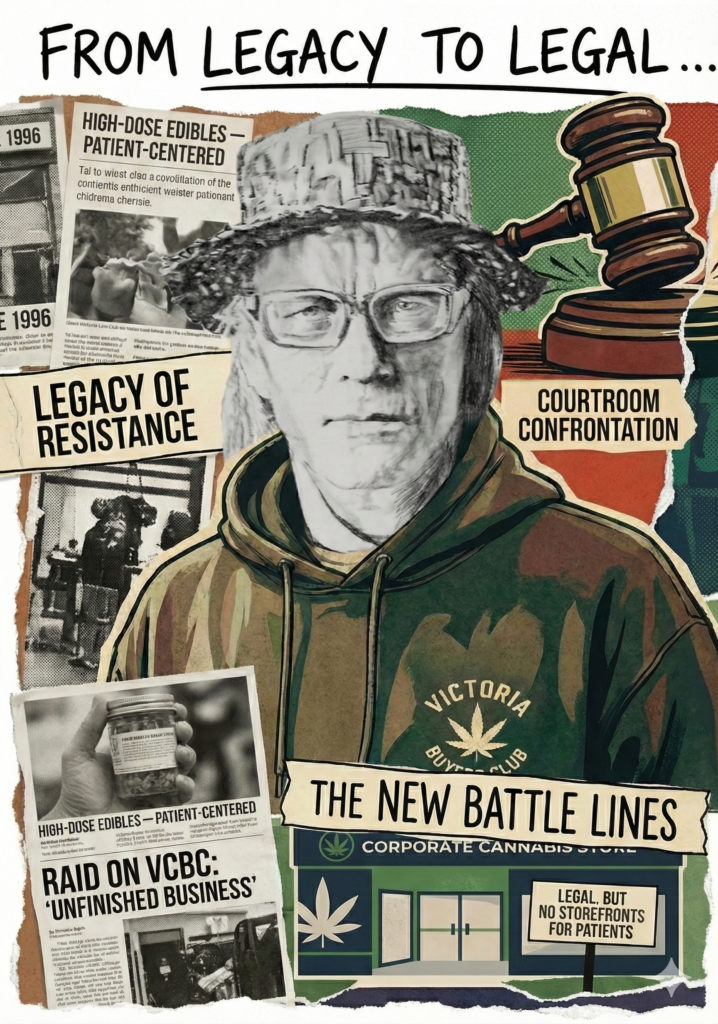 This is the terrain on which the Legacy to Legal panel operates. It is not a nostalgic reflection on a bygone era, nor a grievance session for those who failed to transition into the legal market. It is a formal accounting of structural contradictions that persist beneath the surface of legalization. Ted’s role on the panel represents the position that legitimacy does not flow solely from licensing, and that legality divorced from medical reality is an unstable foundation.
For industry professionals, this perspective is not adversarial; it is instructive. The legal cannabis sector inherits not only a market, but a history of risk, sacrifice, and patient-centered innovation that cannot be erased by regulation. To ignore that lineage is to misunderstand both the source of public trust and the fragility of the current system. The medical cannabis consumer, likewise, remains caught between formal legality and functional access, navigating a system that acknowledges rights in principle while constraining them in practice.
The Grow Up Conference provides a forum where these tensions can be addressed without euphemism. By placing legacy operators and contemporary industry actors on the same stage, the conference acknowledges that cannabis legalization is not a completed project but an ongoing negotiation. Ted’s participation underscores that the question is no longer whether cannabis should be legal, but whether legalization will be just, medically coherent, and historically honest.