LOST: THE WAR ON DRUGS
HOW ACTIVISTS HAVE DISMANTLED THE CONTROLLED DRUGS AND SUBSTANCE ACT.
The War On Drugs has been nothing short than a war on the poor, the sick, the disenfranchised, and people of colour. Prohibition-based drug policies undermine human dignity, erode public health and generate wealth for organized crime. The negative consequences of prohibition, having built up over time, are clearly visible in the downtown core of every single city in the country.
Before we get further into this topic, I should clarify that I am not a lawyer and my opinion should not be taken as legal advice. I have a philosophy degree and have spent much of my career focused on the evolution of litigation in courts in cannabis cases. That does not mean I am an expert in law.
On Sept 29, 2026, a decision from the Supreme Court of BC by Honourable Madam Justice Murray in R. v Kalicum essentially struck down the entire Controlled Drugs and Substances Act. Of course, the government has filed an appeal. This monumental ruling revolves around the activities of the Drug Users Liberation Front (DULF) in the midst of an overwhelming toxic drug crisis, after decades of a brutal War on Drugs.

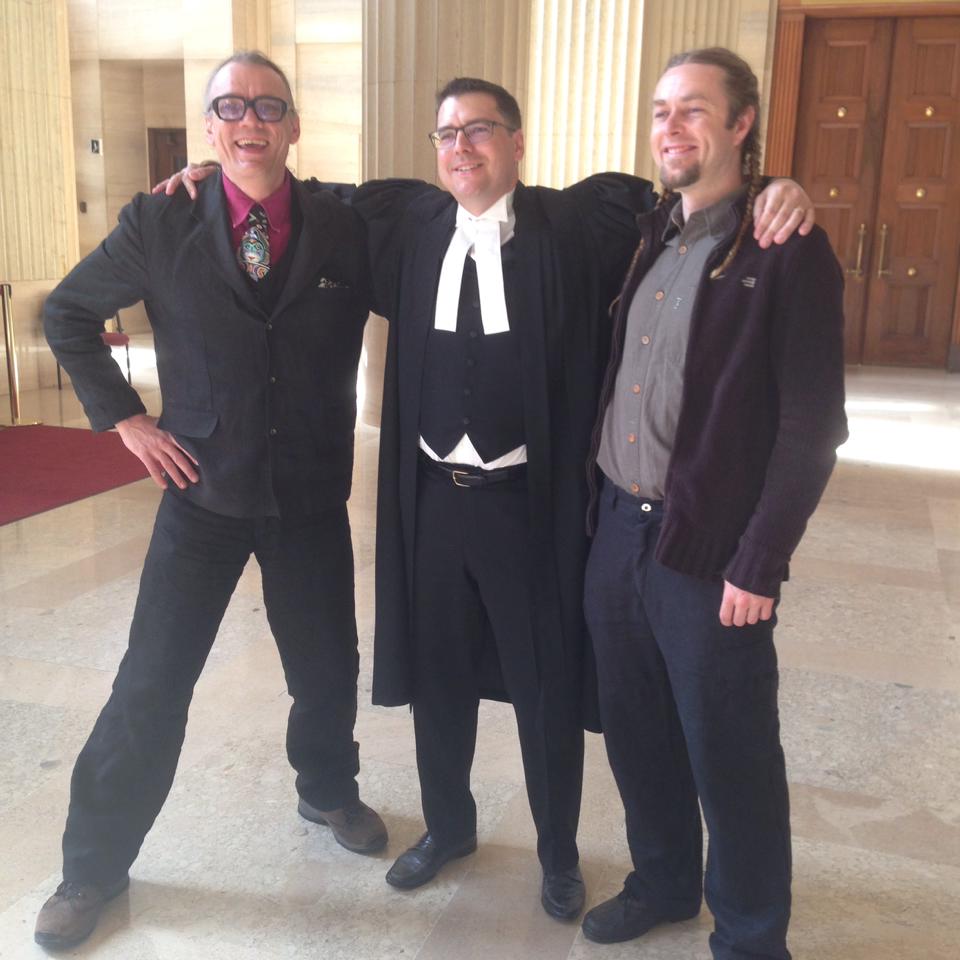
(Jeremy Kalicum and Eris Nyx)
Reactions to this judgement range from rage to joy, confusion to vindication. For Jeremy Kalicum and Eris Nyx, the individuals charged with trafficking cocaine, heroin and methamphetamine, this was far more than relief from facing jail. On the other side, angry calls for Justice Murray to be removed from the bench prompted the president of the Canadian Bar Association, Connor Bildfell, to make the following statement.
“Court decisions can and should be subject to careful scrutiny and vigorous debate. People who disagree with a decision may speak out and challenge its reasoning, and our justice system gives parties an appeal process for challenging decisions where appropriate.
But attacking a judge’s character or fitness—even calling for their removal—goes too far. These kinds of personal attacks risk eroding public confidence in our justice system and collapsing the important distinction between criticizing a decision and attacking the judge who made it. Judges speak only through their decisions and are unable to respond publicly to such personal attacks, making them particularly inappropriate.”
A link to the statement can be found here:
Read the statement from the Canadian Bar Association, BC Branch
The full text of the decision can be found at:
Read the full decision: R. v. Kalicum, 2026 BCSC 1855
As with all court decisions of this nature, few people have the time or ability to read the full text of a judgement. Given the critical impact this decision is going to have on drug policy, it is important for the public to understand how this judgement came to be. This paper is an attempt to explain what this ruling means and how it relates to the fight of the Victoria Cannabis Buyers Club.
- History of medical cannabis compassion clubs
- The toxic drug crisis
- What is DULF?
- Why the exemption process is inadequate and illusionary
- How does the CDSA infringe on the “security of the person” as protected by Section 7 of the Charter of Rights and Freedoms?
- Extraregulatory means of legalizing drugs
- Will this decision open the door for compassion clubs?
- What happens next?

1) History of medical cannabis compassion clubs.
Compassion clubs began distributing cannabis in North America amidst the height of the AIDS crisis in the early 1990s. Starting in San Francisco, groups of individuals formed that were committed to providing relief to patients suffering from the severe effects of AIDS and the drug cocktails being used experimentally to combat it. When it started in 1996, the Victoria Cannabis Buyers Club modeled itself after these pioneers, before the term compassion club was coined.
These compassion clubs provided more than just access to cannabis. They offer peer-to-peer advice, with patients often using their experience using cannabis as a medicine to guide others as they learn what products best suit their needs. In situations where lounges are made available, patients can have opportunities to socialize with other people with disabilities, giving them a chance to further discuss different options in the cannabis medicine cabinet.
In this study titled “The Box Has Become an Indispensable Part of My Life”: A Case Study of Victoria Cannabis Buyers Club and its Consumption Space”, professor Dr. Marilou Gagnon from the Canadian Institute for Substance Use Research discusses the benefits of peer-to-peer counseling.
Read the VCBC consumption-space study
From the beginning, one of the most important products these compassion clubs made available was high-dose edibles. In California, an advocate who became known as Brownie Mary gave hash-infused treats to AIDS patients who would otherwise have been wasting away. In Canada, only a handful of compassion clubs opened in the 1990s, however by the turn of the century, dozens of medical cannabis organizations were popping up across the country.

It is interesting to note that in December 1996 a Harm Reduction Club was formed by David Malmo-Levine in Vancouver, selling cannabis to anyone over the age of 13 until he was arrested. His defense was that youth were particularly vulnerable to the harms of prohibition, arguing that the courts should create a harm principle that would not allow a law to cause more harm than good. In a 6-3 decision in 2003, the Supreme Court of Canada ruled against Malmo-Levine, in a judgement that combined his case with similar defenses being made by Randy Caine and Chris Clay.
When Health Canada was forced to create a medical cannabis program by the courts in 2001, compassion clubs were left entirely out of the picture, as were edibles. Over the next two decades, a series of court decisions struck down the federal medical cannabis program as being unconstitutional, often from cases regarding raids on compassion clubs. However, even after legalization there is no legal framework for a medical cannabis storefront and edibles are restricted to 10 mg per product, leaving compassion clubs that continue to operate exposed to raids, fines and evictions.
An excellent summary of what happened to compassion clubs when legalization occurred in 2018 is provided in this research paper by Dr. Marilou Gagnon.
Read the research on compassion clubs and legalization
2) The toxic drug crisis.
Now I will start quoting from the decision:
[29] On April 14, 2016, BC declared the toxic drug crisis a public health emergency because of a marked increase in deaths from unregulated drugs. It was the first time a BC Public Health officer had exercised their emergency powers under the Public Health Act, SBC 2008, c 28.
[30] The death rate increased dramatically in the following years reaching a high of 2585 deaths in BC in 2025. That is seven deaths each day. In all, more than 50,000 Canadians including 16,000 British Columbians have died of an overdose since the crisis was declared.
[35] Some experts opine that prohibition – that is, criminalizing the production, possession and sale of drugs – is the ultimate driver of the crisis as it has led to a lack of regulation on the production and content of drugs that are being sold on the streets in Canada. That is not an issue this Court has to decide. What matters for this challenge is that, because the street supply is unregulated, there is no quality control, which allows for this deadly contamination.
[71] Of marked significance, the Crown called no evidence, expert or otherwise, to challenge any of the evidence called by the applicants regarding the toxic drug crisis, measures taken to respond to it, safer supply programs including proposed non-medicalized programs, or DULF’s Compassion Club.
[117] Despite these urgent calls by leading health experts, no Canadian government has implemented a non-medicalized safer supply program using a licit pharmaceutical supply of drugs. The only non-medicalized safer supply program that has ever operated is DULF’s Compassion Club.
[118] All the experts and Dr. Lysyshyn testified that they are strongly of the view that non-medicalized safer supply is urgently needed. There is no evidence to the contrary.
3) What is DULF?
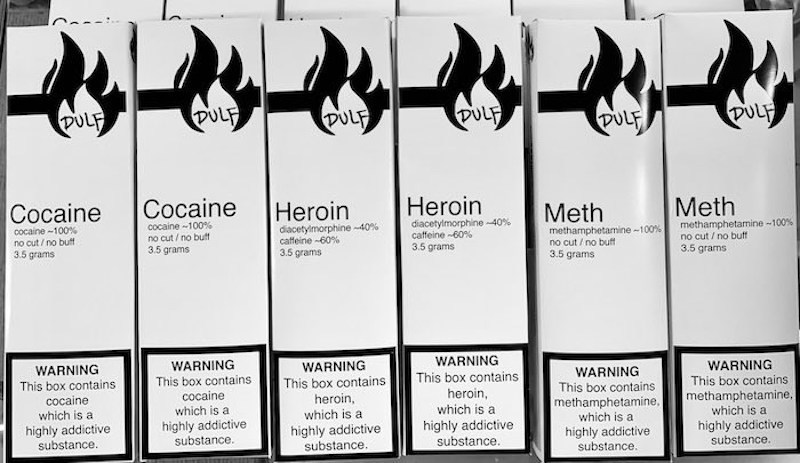
Formed in 2020, the Drug Users Liberation Front was created in the midst of the toxic drug crisis by individuals living on the front line of the war on drugs in the eastside of Vancouver. Providing a safe supply of illegal drugs to people addicted to them was a primary goal of the organization. Members of DULF made extensive efforts to work with public health officials to legally operate a non-medical compassion club.
The province provided a free facility and exemptions to possess illegal drugs for the purposes of testing and for operating a safe consumption site. An exemption to provide harm reduction services was granted by the province but DULF failed to secure an CDSA Exemption 56 for sales. When the final denial for an exemption from Health Canada was received, the founders of DULF responded by purchasing drugs from the dark web and opening up under the watchful eye of local police, politicians and media in August 2022.
This court case was the result of a series of events that led to a raid on DULF after a critical article appeared in The Economist magazine in Sept 2023, just over a year after they began sales.
[60] Pierre Poilievre, leader of the Conservative Party of Canada, told a television news reporter that it was a “disgrace” that the BC NDP would “give hundreds of thousands in tax dollars to illegal drug dealers in addition to decriminalizing hard drugs.” I pause to note that the Vancouver Coastal Health funding given to DULF was to support the overdose prevention site and the drug checking services. In interviews with the media, Mr. Kalicum and Ms. Nyx advised that they purchased the drugs using funds they received from concerned community members, not with the funds they received from the government.
[2] This is an unusual case of possession for the purpose of trafficking. Mr. Kalicum and Ms. Nyx did not possess the drugs to sell for profit. Rather, they had the drugs for a benevolent purpose.
[3] …DULF’s goal is to reduce the harms caused by toxic street drugs.
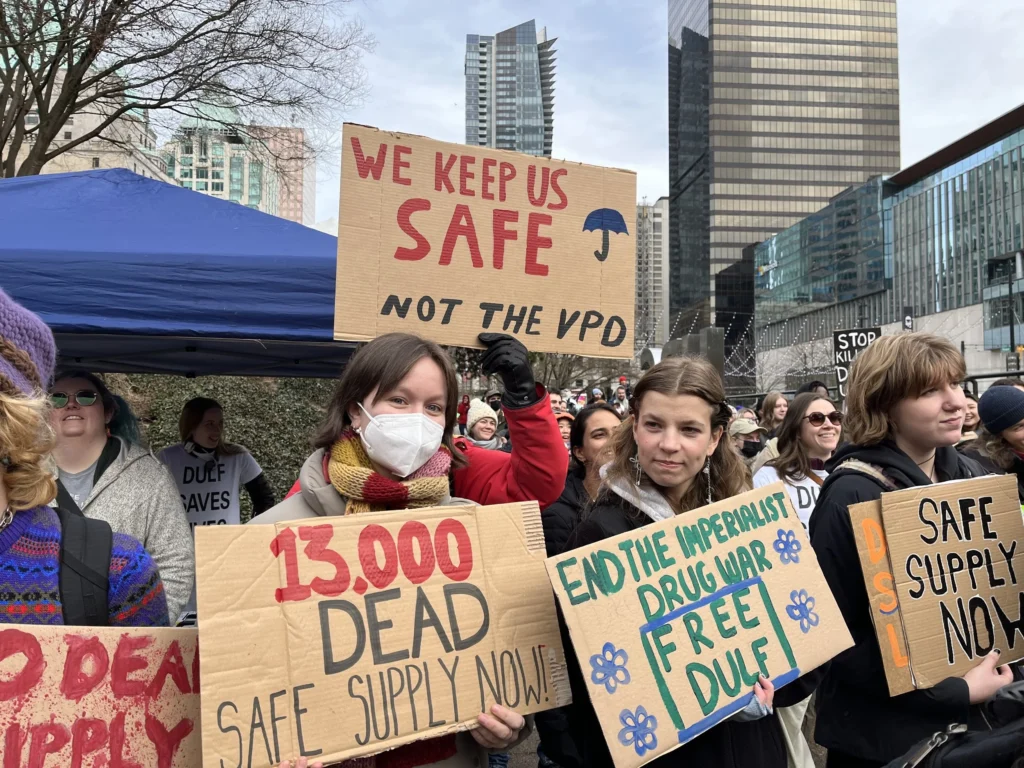
[37] …Mr. Kalicum and Ms. Nyx developed an operating plan for a Compassion Club, a model typically used to distribute drugs that are illegal or otherwise inaccessible to communities in need.
[54] DULF’s pilot project for their Compassion Club worked. In its first year there were no overdoses involving the substances provided at the DULF site. According to Dr. Lysyshyn, that was a promising sign as it showed that the DULF members were not overdosing when using the safe drugs supplied by the Compassion Club.
[129] That DULF reduced the risk of harm caused by the toxic drug crisis accords with common sense. The premise for safer supply programs is undisputed. The toxic drug crisis is caused by the unpredictability of the street supply which puts People Who Use Drugs at risk of overdose every time they use. It is logical that providing them with drugs of known composition and strength, achieved by testing the drugs beforehand, reduces their exposure to that supply and the dangers associated with it.
[130] …“the balance of probabilities may be established by the application of common sense to what is known, even though what is known may be deficient from a scientific point of view”
[141] Drug trafficking and open drug usage are significant public concerns. Violence and drug trafficking go hand in hand. While DULF had to access the illicit drug market to supply the Compassion Club, they sold the drugs to their members indoors in a safe place with controlled entry. DULF also provided members with a safe supervised place to use their drugs, with clean equipment, out of view of the public. The research suggested that the DULF Compassion Club reduced the risk of violence and police interactions for members.
[187] I further agree with the applicants that s 5(2) of the CDSA engages the s7 life and security of the person interests of DULF members. The evidence is consistent and undisputed in establishing the following:
Section 4) DULF reduced the risks of overdose by providing its members with a stable supply of drugs of known composition and potency. It also provided ancillary benefits, such as improved health, reduced exposure to violence and abuse as members did not have to access drugs on the street, and providing the members a community in which they felt comfortable and supported along with a safe place to use drugs.
The impact of DULF closing was stark to its membership. Though it was serving less than 50 individuals, the consistency and quality of the drugs being made available had dramatically improved the lives of the program participants. Testimony from two of DULF’s clients was instrumental in the judge understanding the severity of drug withdrawals and importance of the organization.
4) Why the exemption process is inadequate and illusionary.
Before they began sales, the founders of DULF sought all potential legal avenues for providing a safe supply, including exemptions from the CDSA from Health Canada. While they were able to obtain an exemption to possess illegal substances for the purposes of testing, DULF never received a permit to operate a compassion club from Health Canada despite strong support from the province and virtually every expert of drug policy. A judicial review of Health Canada’s decision to deny DULF’s exemption request has not been completed.
[10] This challenge is about the lack of ability to obtain an exemption. The applicants say there is no pathway through the applicable legislation to permit a non-medicalized safer supply program. They say such a program is urgently needed to address a public health crisis of epic proportions, and prohibiting such a program is an unjustified violation of s 7 and 15 of the Charter.
[17] Section 56(1) is one of the safety valve mechanisms in the CDSA that allows for an exemption from prosecution for otherwise illegal activities. It authorises the federal Minister of Health (“Federal MOH”) to issue exemptions for medical, scientific, and other public interest purposes, as follows:
Exemption by Minister
56 (1) The Minister may, on any terms and conditions that the Minister considers necessary, exempt from the application of all or any of the provisions of this Act or the regulations any person or class of persons or any controlled substance or precursor or any class of either of them if, in the opinion of the Minister, the exemption is necessary for a medical or scientific purpose or is otherwise in the public interest.
[151] The applicants argue there is no pathway available in the legislative regime to operate an urgently needed non-medicalized safer supply program.
[162] Additionally, s 56 of the CDSA is entirely discretionary. It contains no standards and does not require the Federal MOH to prioritize health and safety. The toxic drug crisis is a difficult issue, and a political hot potato. I agree with the applicants that the lack of guardrails leaves it susceptible to political pressure. Section 56 of the CDSA does not contain any procedural safeguards or timelines for ensuring that it can effectively respond to the needs of an urgent public health emergency.
[164] For the reasons above, I find as follows:
Section 4) Accordingly, a s 56 exemption is illusory in this context since a non-medicalized safer supply program is legally and practically incapable of complying with the FDA and FDR.
[165] It follows that there are no legally and practically available safety valves in the CDSA to support the implementation of a non-medicalized safer supply program. Accordingly, if s 5(2) is found to be unconstitutional, s 56 is incapable of curing that unconstitutionality. I turn to that issue now.

This is similar to the experience of the VCBC, which has also applied for a section 56 exemption request that was denied. It is interesting to note that the first legal medical cannabis patients in Canada were given exemptions from the Minister of Health Canada, Alan Rock, but that process was struck down as being unconstitutional for similar reasons to this decision in the Parker decision. While these exemptions exist on paper, to my knowledge there has never been a case where an exemption was granted because it was in the public interest.
When the VCBC was looking for legal assistance for their exemption 56 application to Health Canada, they hired JFK Law Corporation and worked with counsel Tim Dickson. The main reason we chose this law firm was because it had represented First Nations clients in treaty negotiations even though it had no experience with the exemption process or constitutional challenges. We worked together in creating the application, combining my knowledge of cannabis case law with their understanding of administrative law.
Working with Tim Dickson and other lawyers at JFK was expensive and slow but they did a meticulous job with the exemption application. Soon after we filed the exemption 56 application, our former lawyer, Kirk Tousaw, came back into the law field so we switched our legal counsel over to him and Jack Lloyd. After the decision I asked Tim if preparing our exemption 56 and learning the caselaw with us was helpful in preparing the defense for DULF he responded by saying, “…definitely it was – including the famous Smith case! We relied heavily on the cannabis cases.”
In this situation, DULF applied for an exemption 56 from Health Canada before operating. Exemptions from the province for possessing illegal drugs for the purposes of testing were in place. Instead of waiting for a judicial review, they began sales almost immediately after the initial refusal.
In the case of the VCBC, the club was operating long before applying for an exemption 56 and has continued after being given a final denial in May 3023. Since legalization in 2018, the VCBC has been raided four times and has been fined over $3.8 million, with civil forfeiture notices being filed by the province against the current landlord and the home of the VCBC Vice-President, Clea Maclean. The VCBC has applied for a judicial review of their fight with the province to the Supreme Court of BC, though arguments are not directed towards the exemption 56 process specifically and submissions have not been completed.

5) How does the CDSA infringe on the “security of the person” as protected by Section 7 of the Charter of Rights and Freedoms?
The Canadian Charter of Rights and Freedoms has been used by cannabis activists for decades to challenge the underlying ideals of prohibition. To my knowledge, this is the first time Section 7 has been used successfully by individuals supplying other illegal drugs. This decision builds off decades of work that lawyers for medical cannabis patients, growers and dispensaries have been establishing for years.
Relevant cases referred to in the decision include the Parker case that forced Health Canada to create a legal program for access to cannabis as medicine after determining the Exemption 56 process for personal use was inadequate; the Hitzig decision that in 2003 that forced Health Canada to allow the sale of cannabis to patients; and the unanimous Supreme Court of Canada ruling in Smith 2015 that made cannabis concentrates and edibles legal for patients.
[7] …the applicants say s 5(2) of the CDSA infringes on their right to liberty and on DULF members’ right to life and security of the person in a manner that is overbroad and grossly disproportionate, contrary to s 7 of the Charter.
[158] In Hitzig v Canada, 2003 CanLII 30796, 231 DLR (4th) 104 (ONCA) [Hitzig], the Ontario Court of Appeal held that the MMAR violated s 7 of the Charter because it failed to effectively remove the state barriers to a licit source of supply. In reaching this determination, the Court considered these barriers to “encompass a broad array of state actions: the MMAR, the provisions of the FDA and the CDSA and the regulations made thereunder and ultimately the criminal sanction applied to anyone (except select licence holders) who supplies marihuana to an individual with a medical need for it”: Hitzig at para 160.
[172]…Every law that includes incarceration as a possible sanction engages the s 7 liberty interest: PHS at para 87; R v Smith, 2015 SCC 34 at para 17 [Smith]. Security of the person is engaged where state action has the likely effect of seriously impairing a person’s physical or mental health: Chaoulli at paras 111-124.
[173] The SCC has held that barriers on access to medical treatment engage both the right to life and the right to security of the person.

[175] In Parker, the prohibition on possession of medical cannabis in a non-smokable form was held to infringe security of the person: at para 97. Likewise, courts have found that forcing a person to choose between a legal but inadequate treatment, and an illegal but more effective choice, also infringes security of the person.cdsa
[200] …by criminalizing non-medicalized safer supply programs, s 5(2) of the CDSA captures conduct that advances public health and safety rather than impairs it, making the prohibition overbroad.
[202] Accordingly, s 5(2) of the CDSA criminalizes life-saving conduct in a manner that undermines, rather than furthers, the law’s purpose of advancing public health and maintaining public safety. Its impact is completely out of sync with the object of the law… Prohibiting non-medicalized safer supply is therefore grossly disproportionate to the goal of protecting public health and maintaining public safety.
[247]…While the law does have a pressing and substantial objective – that being, the maintenance and promotion of public health and safety (PHS at para 137) – and s 5(2) is rationally connected to that purpose by prohibiting some behaviour that would be contrary to those goals, the means chosen go too far by criminalizing activities that advance, rather than undermine, the CDSA’s objectives. Finding that the law fails at the minimal impairment stage is sufficient to find that it is not saved by s 1.
[257] I make the following orders:
1) Pursuant to s 52(1) of the Constitution Act, 1982, I declare that s 5(2) of the CDSA is of no force or effect because it unjustifiably infringes ss 7 and 15 of the Charter;
2) The declaration of invalidity is suspended for six months from the date of this Order; and
3) Pursuant to s 24(1) of the Charter, the convictions against Jeremy Kalicum and Eris Nyx are hereby stayed.
This effectively means that if the Court of Appeal agrees with this judgement, the government has effectively lost the authority to prosecute individuals arrested for trafficking drugs until a safe supply is available. This is not limited to cocaine, heroin and methamphetamines. The judge determined that all illegal drugs were potentially tainted and life-threatening because of prohibition, and she did not limit the ruling to just the drugs the defendants were arrested with.
There have been times where the cannabis trafficking laws were effectively non-existent in the time periods after similar precedent setting judgements and before Health Canada amendments came into effect. For example, the Hitzig ruling determined that Health Canada needed to create a means for patients to actually purchase cannabis for medical purposes, after Parker had established the fact that cannabis is a medicine that patients should have access to. It was not until amendments were made in law to allow Prairie Plant Systems to sell cannabis to registered patients that the cannabis trafficking laws could be upheld, resulting in thousands of charges across the country being dropped.
One of those cases where charges were dropped was the first trial of the VCBC in 2005. In that decision, Justice Chaperon acknowledged the legislative lacuna Health Canada has created by allowing people to possess cannabis without a source to purchase it. She also expresses frustration with a government that allows illegal harm reduction activities to occur on one hand, while another branch of government proceeds with enforcement actions.
[19] Such people were thus forced to acquire their marihuana on the black market. It is unsettling to contemplate persons with AIDS or who are undergoing cancer treatment being forced to go down to the illegal drug emporium which operates in the downtown core of Victoria to acquire the marijuana for persons who are only interested in selling them drugs of unknown quality for profit. But on January 3, 2002, but for compassion clubs such as Smith’s, that was their only alternative.
[27] On the other hand, the government is relying on these clubs to be the ‘unlicensed reliable supplier’ of medical cannabis to those in need, while on the other hand it was criminalizing their actions and continuing to prosecute them. In so doing it was engendering a disrespect for the law and administration of justice because of the fundamental unfairness of such a position. It has created an alliance between itself and these ‘unlicensed reliable suppliers’, whom it now seeks to prosecute.
This is similar to how health authorities in Vancouver worked with DULF, turning a blind eye to their illegal activities because they were a public benefit, before police decided to intervene and raid the organization.
If the government loses at the BC Court of Appeal decision, they will likely develop an incremental change to the exemption process, the CDSA and/or the FDA in the hope that they can satisfy any future judicial inquiries. One could hope that Health Canada adjusts its mentality towards safe supply and compassion clubs, seriously considering a legal framework for them to operate within. However, one might be more realistic to expect that any changes are minimal and designed to uphold the government’s typically reserved approach to harm reduction measures.
Appealing this decision gives Health Canada policy analysts more time to consider possible avenues for safe supply. With no expert evidence to counter the information provided about the effects of the drug war, the government will not likely succeed in convincing the BC Court of Appeal that Section 7 and 15 of the Charter have not been violated. Any appeal is most likely meant to delay and request the courts consider other remedies.
For those of us who have fought the drug war for decades, losing many friends and loved ones along the way, this judgement validates our efforts to force the government to develop drug policies that respect human rights, promote health and create economic security. The significance of this decision cannot be overstated. This is a huge step forward towards the end of the War On Drugs, which is essentially a war on the poor.
6) Extraregulatory Means of Legalizing Drugs

For many in the harm reduction community, this appears to be the first time a court has struck down the CDSA but that is far from the truth. The cannabis community has had tremendous success in court making similar arguments. We cracked the door open for DULF to bust it down, striking down the foundations of the CDSA.
Over 10 years ago, the VCBC was in Ottawa with lawyer Kirk Tousaw arguing that Health Canada should allow patients to use cannabis in ways other than just smoking dry herbs. While the courts had forced Health Canada to allow access to cannabis in the Parker ruling, they did not allow edibles or extracts to be made with the plant, claiming they were new and different drugs, potentially more dangerous with unknown consequences.
The thought process in the courts for making cannabis extracts legal was similar to the reasoning behind the DULF decision. In the Smith decision, which is ironically named after VCBC employee Owen Smith (no relation) and not myself, the country’s top judges summed it up clearly.
[25] The question is whether there is a connection between the prohibition on non-dried forms of medical marihuana and the health and safety of the patients who qualify for legal access to medical marihuana. The trial judge concluded that for some patients, alternate forms of administration using cannabis derivatives are more effective than inhaling marihuana. He also concluded that the prohibition forces people with a legitimate, legally recognized need to use marihuana to accept the risk of harm to health that may arise from chronic smoking of marihuana. It follows from these findings that the prohibition on non-dried medical marihuana undermines the health and safety of medical marihuana users by diminishing the quality of their medical care. The effects of the prohibition contradict its objective, rendering it arbitrary: see Bedford, at paras. 98-100.
[26] The Crown says there are health risks associated with extracting the active compounds in marihuana for administration via oral or topical products. It argues that there is a rational connection between the state objective of protecting health and safety and a regulatory scheme that only allows access to drugs that are shown by scientific study to be safe and therapeutically effective. We disagree. The evidence accepted at trial did not establish a connection between the restriction and the promotion of health and safety. As we have already said, dried marihuana is not subject to the oversight of the Food and Drugs Act regime. It is therefore difficult to understand why allowing patients to transform dried marihuana into baking oil would put them at greater risk than permitting them to smoke or vaporize dried marihuana. Moreover, the Crown provided no evidence to suggest that it would. In fact, as noted above, some of the materials filed by the Crown mention oral ingestion of cannabis as a viable alternative to smoking marihuana.
[27] Finally, the evidence established no connection between the impugned restriction and attempts to curb the diversion of marihuana into the illegal market. We are left with a total disconnect between the limit on liberty and security of the person imposed by the prohibition and its object. This renders it arbitrary: see Carter v. Canada (Attorney General), 2015 SCC 5, [2015] 1 S.C.R. 331, at para. 83.
[28] We conclude that the prohibition of non-dried forms of medical marihuana limits liberty and security of the person in a manner that is arbitrary and hence is not in accord with the principles of fundamental justice. It therefore violates s. 7 of the Charter.
Crown counsel, Paul Riley, could foresee the DULF decision coming as he faltered in front of the Supreme Court of Canada in the Smith case in March 2015. At one point in his deliberations, Riley acknowledges that the Smith decision could be the downfall of the entire CDSA! Just ten years later his words echo across the country.
About 28 minutes into his arguments, Riley makes the following plea, after explaining how drugs required for medical purposes are supposed to be made legally available:
“Access to drugs in Canada is strictly controlled. There are two statutory pillars: the CDSA and the FDA. These statutes operate together to prohibit access to drugs with a history of abuse, that is the CDSA, and to regulate access to all drugs with a therapeutic purposes, that is the FDA…
There are 3 means of obtaining access to a new drug for therapeutic purposes.
- New drug approval process: As I already pointed out, there are 3 cannabis-based pharmaceuticals that have actually gone through that process. So it is not as though it is impossible.
- Clinical trials: In the course of seeking a new drug approval you can seek approval to conduct a clinical trial of a substance that has not yet been approved for use.
- Special access program: This is a case-by-case authorization to use a presently unapproved drug based on a demonstrated need by a physician in a particular case…So this drug is cutting edge and controversial but here I have a patient that cannot be treated by any other means so I want special access. That is a very nimble element of the scheme.
But I will say this, on the approach the courts have taken, there appears to be a fourth means of obtaining access to a new drug in Canada. The fourth means is what I would describe as an extraregulatory means.
You produce the drug. You distribute it. And if you are prosecuted you can call evidence in court to prove on an anecdotal basis that someone believes they need the drug and that it helps them. That is the fourth extraregulatory model. Now there are court cases where this has happened, most notably Parker.
The concern that I identified highlights the need for deference where courts are being asked to pronounce on the manner in which Health Canada classifies, regulates and approves drugs for therapeutic purposes. If it is not carefully circumscribed, this fourth route has the potential to overwhelm or overtake the entire premise of the regulatory model, which is that drugs should not be made available for therapeutic purposes unless shown by science to be safe and effective.”
A decade after these words were spoken to the high court, the CDSA has been struck a death blow!

7) Will this decision open the door for compassion clubs?
The crown has appealed this decision for a few reasons. However, the decision cannot be easily overturned because the government brought no expert evidence in its defense. Presumably, the government has filed an appeal to buy time to generate some solutions that the courts might accept and to get more clarification from the bench regarding what remedies might be acceptable.
In the meantime, this has convinced many to push forward and begin safe supply compassion clubs, as the death toll is not really slowing down. Former BC Chief Medical Officer of Health, Dr Perry Kendall, agrees that Health Canada needs to consider including community-based, non-profit distribution of drugs as a potential solution to the toxic drug crisis. After the ruling was handed down he made the following statement online.
“This is a very significant judgement by Justice Murray. The next step must be for the Canadian Government to review the Controlled Drugs and Substances Act and the Food and Drugs Act with the explicit purpose of addressing a) the paradoxical impact of Prohibition and b) a shorter (much shorter) workaround that would allow, under section 56 of the CDSA, evaluable Compassion Club models of Safer Supply.”
Reflecting on how medical cannabis compassion clubs developed as the caselaw evolved provides valuable insight to possible scenarios that may occur now. The road to legalizing cannabis was paved partially by a series of court decisions, and partially by pressure from activists who opened medical cannabis dispensaries in defiance of the law. Following the pathway established by cannabis activists could provide non-medical compassion clubs some guidance.
There are two trains of thought running parallel to each other: the legal precedents and the court of public opinion. The court of public opinion is a little more important than the courthouse because it is easier to overturn a court decision than it is to turn public opinion around. Unfortunately public opinion has been going against harm reduction recently, so we need to take advantage of this case with measured actions that will ensure success in court, political assemblies and in the streets.
For a few reasons it makes sense to have compassion clubs run under separate management rather than having a non-profit society try to operate several locations. Communities will be much more accepting of local compassion clubs being managed by familiar faces rather than having a larger organization based in Vancouver branching across the province. Having some diversity in the compassion club field also allows for some variations in function which over time lead towards best practices for everyone.
Having multiple smaller, independent groups is preferable for legal reasons, especially in the early days when many of these facilities will be technically illegal. Working illegally demands certain actions are done personally, like getting bank accounts to be able to pay for supplies, utilities or other operational expenses. Any enforcement actions will be more complicated for the authorities if these non-medical compassion clubs have different individuals responsible for daily operations rather than one large group managing several locations.
It might make sense for some of these compassion clubs to focus on one drug rather than several like DULF. Trying to manage supply for multiple drugs will be difficult, unless sympathetic suppliers begin to appear. Maintaining storefront access might be financially and politically more difficult than setting up a delivery system, especially in the early stages.
These organizations should form an association that can speak to the government as a group, which is how most industries lobby. It took 15 years for cannabis compassion clubs to form an official association, the Canadian Association of Medical Cannabis Dispensaries, something that will hopefully happen much sooner with this new breed of compassion clubs. A professional association of compassion clubs would be able to provide various supports to organizations entering into the field, supporting harm reduction research and advocacy, while lobbying to various government entities.
Medical cannabis compassion clubs formed a foundation upon which legalization took root. Though these organizations have been excluded from the legal framework, they have been instrumental in pushing the government towards better regulations while providing relief to patients who had no acceptable legal alternative. Learning from their collective experience will provide the next phase of non-medical compassion clubs valuable insight.
8) What happens next?
With the toxic drug crisis taking lives daily, there is no time to wait for the government to respond with adequate measures to address the size and severity of the problems. While various government agencies and individuals in the health care system may strive to create functional safe supply, it will be years before evidence from a pilot project will encourage expansion beyond Vancouver. Ultimately, the legalization of all drugs needs to happen to resolve the situation for the general public and not solely for the protection of people seriously addicted to drugs.
At this point it is worth bringing another group of drugs into the conversation: psychedelics. Almost immediately after the Smith decision, it was clear a similar pathway could be taken by individuals interested in using psychedelic drugs for various medical purposes. Some researchers choose the Exemption 56 route, with some success, while others simply opened up unlicensed mushroom dispensaries.
While some enforcement actions have been taken against these mushroom dispensaries, most have withstood the initial assaults and remained open. Many major cities now have unlicensed storefront mushroom dispensaries, with Vancouver having as many as 12, which work hand-in-hand with a flourishing on-line industry. For the most part authorities seem unsure what to do about the situation, as there are few complaints about these businesses and it is unlikely that anyone will be convicted of breaking the law.
Research into psychedelics is expanding into several areas, from palliative care with cancer patients, to migraines and PTSD. A whole class of drugs that was prohibited are now becoming available to researchers, including LSD, mushrooms, DMT, ketamine, peyote, and MDMA, aka ecstasy. Indeed, just like cannabis, the increase in interest and availability of psychedelics for medical purposes is happening around the world.
There is a lot of interest in producing these substances legally, for research and sales. The pathway towards legal production of psychedelics is more developed than the means to produce so-called hard drugs like cocaine and heroin. However, with this court case now opening the door for safe supply of drugs, no doubt pharmaceutical companies are scrambling to develop unique forms of administering these substances.
Drugs are starting to win the war, but it is far from over. Now the public needs to be brought fully onboard. There is no easy way to do that.
Hosting conferences, and other opportunities for the general public to hear directly from academics, politicians, activists, health officials, drug users, and other affected communities serves multiple purposes. These educational forums build networks of like-minded advocates who encourage, inspire and inform each other in ways that cannot happen on-line. More importantly, these discussions inform the public about the hard truths of drug use and harm reduction without mainstream media controlling the dialogue with sound bites.
Ending the War on Drugs and legalizing these substances will be a long, difficult process. How things proceed depends on several factors but one thing is certain: prohibition has failed. The War on Drugs has been an absolute failure by every possible measurement. It is time for civilization to rise above these barbaric laws and treat drug use as a health matter, not a criminal one.